Category: History

  • Bullets, beer, and Bavarians at Schuetzen Park

    Bullets, beer, and Bavarians at Schuetzen Park


    UPDATE (July 12, 2017): Thanks to reader George Lane, we have a picture of the “flying horses” (aka a merry go round) built in 1873 at Schuetzen Park.
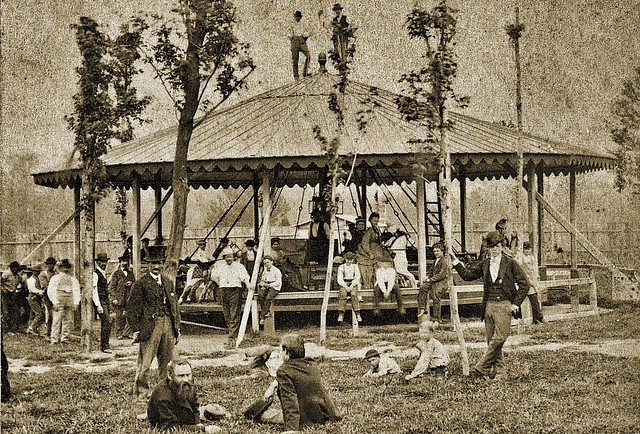
    Whirligig in Shützen Park, Philadelphia Sep. 1873

    According to George, the pic is of the newly built merry go round (also called ‘flying horses’) in Sept. 1873. While the men were shooting, the women and children enjoyed the other features of the park.

    To see the original, check out George’s Flickr. Thank you very much George for the beautiful pic!


    Original article (May 2014)

    Unless you’re from Georgia, guns and beer don’t mix, right? 

    It seems crazy now, but there was a time when it was perfectly acceptable in Philadelphia to spend a day shooting and drinking – and Schuetzen Park in East Falls was a popular place to do it.

    Schuetzen Park 1875. The park was located on the present-day site of the Queen Lane Reservoir.
    Schuetzen Park 1875. The park was located on the present-day site of the Queen Lane Reservoir.

    The 19.5 acre park, located on Indian Queen Lane not far from Hohenadel House, was purchased in 1870 by a German-American rifle club called the Philadelphia “Schuetzen Verein” (directly translated from German as “Shooting Club”).

    Club members practiced both short and long-range shooting at various wooden targets and, with the advent of the clay targets in the late nineteenth century, trap shooting. They often participated in matches that pitted individual shooters, as well as communities and clubs, against each other. This 1869 photo below depicts hundreds of members of Philadelphia’s German-American shooting club — their faces copied from photographs — on their shooting grounds off Indian Queen Lane in East Falls.

    The Philadelphia Schuetzen Verein 1869. Source: Philadelphia Library Company
    The Philadelphia Schuetzen Verein 1869. At the center of the group, a man wears a sash and holds the banner of the club. Also shows the banquet hall and members taking target practice in the background. Source: Philadelphia Library Company

    The club also held Schutzenfests, shooting festivals whose origins dated back to the Middle Ages in Germanic parts of Europe. Winners received trophies, prizes, and local and regional recognition from their victories. The festivals were also occasions to express German pride as well as patriotic sentiments about the United States and the role of Germans in building the nation.

    These expressions seemed necessary, given that many Americans in the late 19th century believed that Germans were “foreigners” and not “real Americans.” At a Schuetzen Park festival in 1882, a speaker claimed that Daniel Pastorius, the founder of Germantown, arrived shortly before William Penn, proving that the “German stock took root at the same time as the English” in the founding of Pennsylvania.

    Daily life at Schuetzen Park was quite colorful, as described in the Philadelphia Times (August 6, 1893):

    “On every Thursday morning during the summer the men of the club repaired with their rifles and banged away at the targets with most encouraging results. In the afternoons the children, wives, and sweethearts of the marksmen went out from the city with baskets fairly groaning under their wealth of good things and the remainder of the day and evening was spent in dancing and merry-making.”

    Some of the Park’s amenities included a “dancing hall, swings, flying horses, stables, a music room” and, of course, a German specialty whose popularity was then sweeping the nation — lager beer.

    The Park’s greatest moments were on May 15 and 16, 1871, when the German victory in the Franco-Prussian War sparked a massive celebration at Schuetzen Park. Reports at the time mention a “nine-mile long” procession of revelers in Philadelphia, many of whom found their way to the new park.

    Attendance at Schuetzen began to wane in the 1880s with the passage of the Brooks High-License Act, which regulated the sale of alcohol in Pennsylvania and increased the prices of liquor licenses. The result, according to The Philadelphia Times, “did away with the greatest source of revenue for the picnics held at Schuetzen Park.” The Park was eventually condemned in 1893 to make room for the new reservoir and the club began a search for a new park. Locations such as Pastorius Park were considered, but were discarded because Chestnut Hill was considered too built up for the discharge of firearms in its vicinity.

  • Prime of Life

    Prime of Life

    Fallsers know him, but unless you were born here or happen to collect Big Band records, the name “Harry Prime” might’ve slipped under your musical radar. What a shame. (more…)

  • The Social Lives of East Falls’ Elite

    The Social Lives of East Falls’ Elite

    Local newspapers are a great source of juicy neighborhood details you won’t find anywhere else.  (more…)

  • A Brief History of East Falls – Bottle Edition

    A Brief History of East Falls – Bottle Edition

    It’s amazing what kind of history you can find under your feet. Aaron Bechtel, bottle collector and local historian, made his first find by accident in 2006 on a hike in the Wissahickon. (more…)

  • When Hohenadel Lost (some of) His Family Jewels…

    When Hohenadel Lost (some of) His Family Jewels…

    Thank you, John C. Hohenadel of Lancaster, PA — a distant relative of our own “brewer branch” here in East Falls. He’s been collecting Hohenadel breweriana for over 30 years, and also has uncovered lots of interesting clippings he’s been so very kind to share with us.

    Here’s one from a break & enter at the mansion on Indian Queen Lane  (from the Evening Public Ledger, January 26, 1918):

    (more…)

  • We Hear from Another Hohenadel:   Great Grandmother Adopted Jacob’s Orphans?

    We Hear from Another Hohenadel: Great Grandmother Adopted Jacob’s Orphans?

    East Falls House joins forces with another Hohenadel — this one keenly interested in her family background.  So far we’ve only made first contact, stay tuned as our story develops to present a clearer picture of these German immigrants who built a small local empire with their native brew.

    Our recent email exchange bodes well:
    (more…)

  • Another East Falls Ghost Story from the Chadwick Papers:  Rittenhousetown

    Another East Falls Ghost Story from the Chadwick Papers: Rittenhousetown

    Our local ghost stories continue with this latest tale from the Evening Bulletin, April 8 1932, about the ghost of a sad, suicidal tenant who once boarded there with early Rittenhouses.  (more…)

  • “A whole website about my family? How… underwhelming…”

    “A whole website about my family? How… underwhelming…”

    Back in August, we discovered an article in an old Penn Charter Newsletter that interviewed John Jacob Hohenadel, Jr — grandson of John W. Hohenadel who ran the brewery at the height of its success in the early 20th century.  (more…)

  • Ghosts Tales from East Falls’ Mysterious Past

    These ghost stories come to us from the Chadwick Papers — clippings from the now-defunct local newspaper “The Suburban Press” by the paper’s editor in the 1930’s, Alex C. Chadwick. Transcribed and unedited, below, they’re a time capsule of sorts for scary storytelling 75 years ago.
    (more…)

  • Lager? I Barely Know Her…

    Lager? I Barely Know Her…

    Q: How do you turn German beer into American beer?
    A: Drink it.

    Poor American lager. A whole generation of craft beer lovers grew up associating this once-noble Old World recipe with the thin, low-alcohol stuff favored by rednecks and underage drinkers. (more…)