Author: East Falls Dog Walker

  • Philadelphia Herald October 15, 1925: East Falls Brewery History

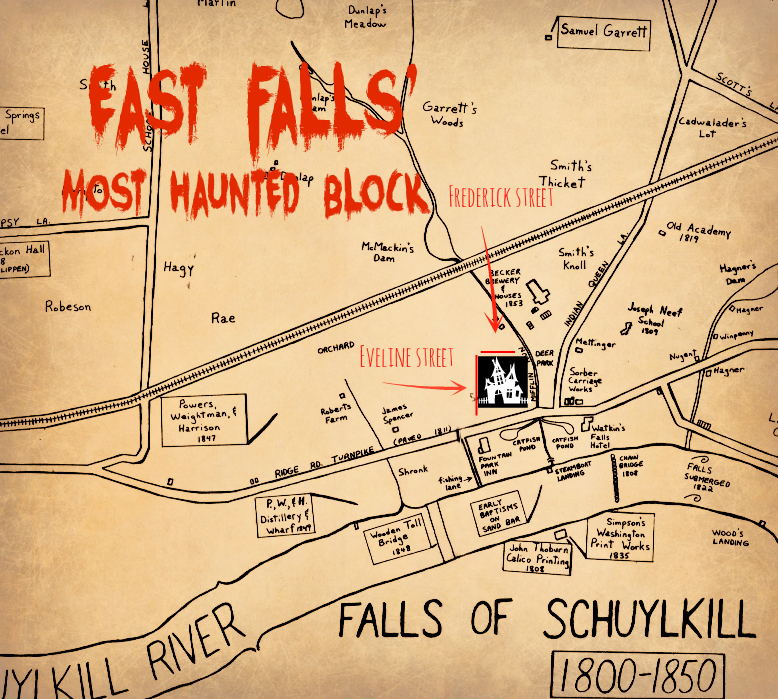
    Until recently the ground bounded by the Norristown Branch of the Reading, the rear property line of the north side of Queen lane and the south side of Midvale avenue, down to Cresswell street, was a part of the Whiehle estate.

    A part of the ground, which was sold some years ago to the Wardens, was occupied by a huge brewery which has become a thing of the past. It was erected in 1856, by the late Henry J. Becker, a German stone-mason, who had settled some years before in the Falls, and began to “plunge” on building operations.

    The brewery, at one time the largest building in the neighborhood, stood on a point of ground known as Smith’s knoll, where Smith’s and Mifflin’s Hollows joined and formed a triangular-shaped plot with the railroad for a base. The hill was covered with blackberry bushes and small underbrush.

    Becker formed a partnership with Joseph Steppacher to brew beer. Becker, a Free Mason, had a large stone set in the front of the building on which was carved the compass, square, trowel and other emblems of the order.

    The underbrush was removed from the surrounding land and a saloon was opened near the railroad track, which, with dancing and other pavilions, became known as the Falls of Schylkill Park. The saloon had at one time as proprietor a man named Ritter who was of a family which has since acquired a reputation in the canning industry.

    Becker did not remain long in the brewery business. It being said that he withdrew in order to save what little money he had left. Steppacher continued until the early seventies and was succeeded by the late John Hohenadel, who rented the property from the William Stoner estate. Centennial year, 1876, the greater part of the brewery was consumed by fire. Hohenadel, in an effort to save some of his valuables, had to be restrained from entering the building while the conflagration was at its height.

    Before the present East Falls station was erected, the brewery had been used for years as a coal and lumber yard. The Warden estate disposed of this part of the ground, to the Reading Railroad Company as a site for the station.

    The remainder of the property, including ten dwellings on Whiehle street, with the ground along the railroad and down through old Smith’s Hollow, has recently be acquired by Gottlob Steinle.

    CHADWICK East Falls Brewery History Phila Herald 1925

  • Last Chance Landscaping: Crepe Myrtle TO DIE in 72 Hours

    Last Chance Landscaping: Crepe Myrtle TO DIE in 72 Hours

    Grant Hohenadel’s lovely crepe myrtle a stay of execution, if you can. Pro-flora contractor Mike Labetti has tried to figure out a way to save ‘er, but she’s just too big to work around. Monday, she’s gotta go. (more…)

  • Harry Prime Looks Forward to his Big Night

    Harry Prime Looks Forward to his Big Night

    Last week, Harry Prime came out to Epicure Cafe to meet Hohenadel House’s Felicite Moorman, and have a look around the grand ballroom he’ll be performing this October 18th. He brought his friend, fellow performer Bill Parsons, for a nice lunch and then a tour of the mansion.
    (more…)

  • Gertrude Hohenadel 1835- 1907 (niece of East Falls’ brewer Jacob)

    This Hohenadel’s history — culled from various online geneology sites — crosses paths with “our” Hohenadels here in East Falls (scroll down), and illuminates the struggles and hardships early generations endured, working towards the American Dream.

    Sources were traced whenever possible but unfortunately most of these facts below remain undocumented. Grain of salt.   — EFHS

    Gertrude Höhenadel (the younger) was born November of 1835 in the town of Mörlenbach in Darmstadt Hesse, Germany to Jacob Höhenadel (b. 1796) and Gertrud Rech (b. Oct 3, 1815 in Mörlenbach, Germany). She immigrated to Philadelphia in 1853 at the age of 18, was the daughter of a successful tavern-keeper and was also a member of the Höhenadel family consortium of Philadelphia taverns, hotels and breweries. Her mother Gertrud Rech Höhenadel (the elder) and brothers are documented as immigrating to America on the S.S. Silas Greenman which sailed from LeHavre, France and arrived in New York Harbor on December 21, 1854. It is not known when Gertrude’s father Jacob (born July 26, 1796) sailed to America, but it is most likely that he arrived in the late 1840s or early 1850s. By the 1860s, Gertrude’s family was well-established in the city of Philadelphia. Gertude (the younger) had at least two brothers named Jacob and Johann who also came to America. Jacob was born in 1839 and Johann in 1845.

    Gertrude Höhenadel (the younger) and her future husband Wilhelm Biermaas most likely met through the Philadelphia hospitality business since Wilhelm was a baker and Gertrude the daughter of a tavern-keeper. Wilhelm Biermaas had been born on December 4, 1814/1818 in the town of Holzheim in Prussian Germany to parents from the town of Nassau. Wilhelm was Catholic. According to his naturalization papers, Wilhelm immigrated to America around the year 1834 when he was 21 years old. Wilhelm found work as a baker in Philadelphia. After five years of residency in the United States, Wilhelm filed his Declaration of Intention for his American citizenship with the Quarter Sessions Court of Philadelphia on April 20, 1860. 

    Gertrude Höhenadel and Wilhelm Biermaas married around the year 1854 and established a household at 1216 N 12th Street, which included Gertrude’s parents, her brother John Höhenadel (a baker), Joseph Höhenadel (a possible cousin from Prussia and a baker) and another baker named John Hoffman. The newly married couple gave birth to daughter Elizabeth Gertrude Biermaas in November of 1855. They would also become the parents of John Biermaas who was born circa 1860 and would become a baker as well and Gertrude Biermaas who was born in April of 1867 and died one year later on Dec 15, 1868. The Wilhelm Biermaas family ran a large bakery out of their home which was mostly staffed by members of the Biermaas and Höhenadel families 

    Gertrude’s mother Gertrude Rech Hohenadel (the elder) died in May of 1871 and was buried May 17, 1871 in New Cathedral Cemetery in Philadelphia in an 8-grave lot purchased by Gertrude and her husband William Biermaas. Gertrude Hohenadel (the elder’s) age is listed as 36 years old on her burial record, but she was 56 at the time of her death, with the 36 most likely being a transcription mistake. Her father Jacob Hohenadel died on August 4, 1875 at the age of 79 and 11 days. He was interred along with his wife in New Cathedral Cemetery, Section D, Range 4, Lot. 22. There is no gravestone marking their resting place. New Cathedral Cemetery is located at 3801 N. 2nd Street in Philadelphia with phone number (215) 634-3212. 

    Wilhelm Biermaas, or William Bierman as he is known on his death record, lived to the very old age of 92 which was almost unheard of in the 1800s. He died of apoplexy at the age of 92 on May 15, 1905 and was interred at New Cathedral Cemetery on May 18, 1905 with his Hohenadel in-laws. His wife Gertrude (the younger) died at the age of 71 of valvular heart disease at the residence of her daughter at 7th and Swarthmore Ave. in Folsom, Pennsylvania. She died on March 20, 1907. Her funeral service was held at St. Peter’s Roman Catholic Church at 5th and Girard Avenue at 11:30 am. She was interred at New Cathedral Cemetery, Section D, Range 4, Lot. 22 with her husband and parents on May 23, 1907. There is no gravestone to mark the Biermaas/Hohenadel graves. 

    Similar to the William Biermaas family, the Höhenadel family built an even greater legacy in the hospitality culture of Philadelphia and even had a street named after them. While Gertrude Höhenadel’s father was a tavern-keeper, other close members of the family also started successful businesses in Philadelphia. Gertrude’s brother John Höhenadel was both a baker and a hotel keeper on Queen Street. He married a woman named Wilhelmina and raised two sons and two daughters. Another relative named John Höhenadel (b. 1823 and very likely Gertrude’s cousin) founded the lucrative City Park Hotel and saloon business at a busy railroad terminus and at the entrance of the lovely recreational Fairmount Park. An advertisement in the 1872 Fairmount Park guidebook proclaimed the City Park Hotel as offering”Lager Beer, Wine and Ice Cream Garden and Saloon. Parties served at short notice with all the delicacies of the season.

    Jacob Höhenadel, brother of City Park Hotel owner John Höhenadel, was born in 1838, immigrated on the same boat as Gertrude’s mother and brothers, and founded the Schuylkill Falls Park Brewery. An advertisement in an 1872 Fairmount Park Guidebook said of the Falls Brewery: “SCHUYLKILL FALLS PARK BREWERY, HOTEL, SUMMER GARDEN, AND TEN PIN ALLEY. All the Luxuries of the Falls made a Specialty. The place can be reached at any hour by Philadelphia & Norristown R. R., Ridge Avenue and Malayan Railway Cars, and Schuylkill Steamers. This is the only and best place near the city for Excursions, Parties, Picnics etc. 

    The various members of the Höhenadel family all lived within a few miles of each other and ran their businesses in conjunction with one another. The Schuylkill Falls Park Brewery appears to have been located in Dutch Hollow. Dutch Hollow was built by a German stonemason in the 1850s and consisted of two streets (today known as Arnold and Creswell) and a brewery behind the East Falls train station. In fact, Arnold Street appeared on city maps as Hohenadel Street until the end of the nineteenth century. Jacob Hohenadel bought the brewery and an additional six acres all the way back to Indian Queen Lane for this hotel / brewery. The property also contained two caves used to refrigerate beer (and employed in succeeding years by Falls teenagers for various illicit purposes). The City Park Hotel owned by John Höhenadel was located in the Brewerytown entrance to Fairmount Park at 29th Street and Pennsylvania Avenue and the John Höhenadel family lived on Girard Avenue in Brewertown. The Gertrude Höhenadel family lived on North 12th Street and the brewer Jacob Höhenadel lived on Broad Street with his family.

    Brewer Jacob Höhenadel had started out as a bookkeeper at the Bergdoll Brewery in the 1850-1860s, then according to the Philadelphia city directories began manufacturing lager beer around the year 1861 at 311 Brown Street. The factory was begun around the year 1958 per the Hexamer General Surveys, Volume 6, Plate 468 stored at the Free Library of Philadelphia. His business developed into the Schuylkill Falls Park Brewery, so named because it was located next to the local waterfall and park as well as next to the railroad tracks. The brewery is described as follows in the Hexamer General Survey: “Brewery situated at Schuylkill Falls, 21st Ward, Philadelphia-Buildings erected 1858.- Scuttle & stairs to the roof.- Cornice of wood.- Walls 2.5 feet thick.- Floor of the brewing room of wood.- Premises warmed by the natural heat of brewing kettles & 1 cooking stove in kitchen of 3rd floor, well secured.- No other fires on the premises.- Fuel Anthracite coal.- Rooms lighted by stearine candles.- No steamboiler on the premises.- No new barrels manufactured at the place.- Few wood sharings made in coopering shed.- Lightning rod with 3 points on the building.- Hoisting apparatus outside, at ( C ) on plan, communicating with every floor.- No ladders on hand.- Large wooden watertank in the brewing room, 10 feet above the ground, containing about 64,000 gallons of water, supplied by a never failing spring.- 400 feet 1.5 inch india rubber hose kept on different places of the brewery which can be attached to 2 watercocks on watertank in case of fire.- No other provisions for extinguishing fire.- No watchman on the premises.- Hands employed living in the building.- 2 brewing kettles, marked ( A) & ( B ) on plan (32 & 72 barrels), in the brewing room, enclosed by brickwalls with brick under, in proper distance of woodworks.- No malt kiln or still on the premises.-Lager beer manufactured only.- External exposures as per plan.- Care in management & general condition of the property: good.-“

     Although the Jacob Höhenadel family appeared to have the idyllic life, living in a lovely 2.5 story stone home with a front porch overlooking their beer manufacturing plant, life as a brewery owner took its tragic toll on Jacob Höhenadel and his family. It would appear that tuberculosis and related infections ran rampant around the beer manufacturing plant. His daughter Sohia died at 9 months old on Feb 18, 1865. Jacob’s 16-month old daughter Charlotte died of a lung infection on Sep 22, 1870 followed later that year on Dec 17, 1870 by the death of Jacob’s 4-month old son of spasms.

    On, February 27, 1874, the first women’s temperance demonstration were held in Philadelphia against taverns and lager beer saloons in imitation of proceedings in Ohio and other Western States. About twenty women visited three or four saloons in the neighborhood of Susquehanna Avenue and Fifth Street, Sang hymns in front of these places and delivered prayers. None of the saloons closed. On October 29, 1874 the Schuylkill Falls Park Brewery set fire and burned down with a loss of $45,000.

    After the fire of 1874, the curse of the Höhenadel brewery continued. Owner Jacob Höhenadel himself died from congestion of the brain on July 21, 1876 at the age of 38 followed one month later by the death of his wife Johanna by a lung infection. The four remaining Höhenadel children were divided among the surviving relatives. 12-year-old Elizabeth and 4-year-old Joseph moved into the household of their cousin Gertrude Höhenadel and her husband Wilhelm Biermaas. It is not known what happened to Elizabeth Höhenadel after the 1880 federal census but it is known that tragedy continued to follow her brother Joseph Höhenadel who would die of tuberculosis at the age of 23.

    7-year-old Hannah Höhenadel and 1-year-old Amelia Höhenadel moved in with their paternal uncle, the aging Rev. John Höhenadel who was also the owner of City Park Hotel. Hannah Höhenadel lived to marry Charles Steinmuller and gave birth to a son named Roy Eric Steinmuller. However, Hannah also died sadly at the age of 24 of tuberculosis, with her 2-year-old son dying a day later of malnourishment. Sister Amelia Höhenadel who was only 1-years-old when her parents died was the only known long-lived member of the family, living to be 105 years old before dying in Philadephia in February of 1980.

    The ill-fated Schuylkill Falls Park Brewery was passed on to the Rev. John Höhenadel who changed its name to the John Hohenadel brewery. The 60-year-old Rev. John Höhenadel would die of bronchial pneumonia on Mar 16, 1884. After his death, his son John did not inherit the brewery because he was a successful machinest. Instead, the brewery passed into the hands of another Höhenadel relative, John William Höhenadel who had worked his way up through the family business ranks from German immigrant, to baker, to brewer and finally to the owner of the John Hohenadel Brewery. John William Höhenadel would relocate the brewery to Conrad and Indian Queen Street between the years 1888 and 1894. He and his wife moved to 3617 Indian Queen Lane in East Falls, Philadelphia into the Hohenadel Mansion which was two doors down the hill from The Falls of the Schuylkill Baptist Church. A succession of church pastors occupied the house between the Church and the Hohenadel house. One can only speculate about the relationship between the alcohol-averse Baptist preachers and their brewer neighbors.

    The curse of the Höhenadel brewery continued into the next generation of ownership. John William Höhenadel served as owner for only three years before he too died of a lung infection at the age of 46 on Sep. 8, 1887. His wife Maria Höhenadel became the next proprietor of the family brewery.

    Maria Höhenadel carried on the family business even amidst her own personal trageies. She lost her eldest son Jacob at the age of 2 days old in 1865, her 5-month-old daughter Gertrude on July 12, 1875 of whooping cough and her 28-year-old son Ferdinand on Sep 25, 1892. Her third son John W. Höhenadel would eventually inherit the John Hohenadel Brewery from his mother and break its curse around the year 1900. He would launch it into an era of economic prosperity. He became president of the Bank of East Falls and opened Hohenadel’s Hotel before closing the brewery for good on Dec. 31, 1953 due to competition from larger breweries in Philadelphia.

     In the 1930s the Hohenadel family left East Falls for the Kenilworth apartments in Germantown.


  • Ghosts Tales from East Falls’ Mysterious Past

    These ghost stories come to us from the Chadwick Papers — clippings from the now-defunct local newspaper “The Suburban Press” by the paper’s editor in the 1930’s, Alex C. Chadwick. Transcribed and unedited, below, they’re a time capsule of sorts for scary storytelling 75 years ago.
    (more…)

  • Lord, Beer Our Prayer

    Long before science explained the chemical interactions that made the magic of beer, medieval brewers believed that beer could be demonically possessed. Somehow evil spirits during the brewing process made your beer flat or skunked or just off. Good beer, on the other hand, was the work of angels. So brewers hired priests to watch over the brewing process and ensure divine intervention.

    This was an expensive service, given that priests were busy in those days casting out demons all over the countryside and calculating the number of angels on pinheads. To compensate them for blessing beer, called the Rite of Signage, brewers paid priests four pints per blessing. Those lucky priests had it good and the church benefited financially from a tax system that later developed from it.

    Now that we know the science of beer, some churches are looking to profit from beer in a different way. Theology on Tap, Spirituality on Tap, Beer and Hymns — whatever you want to call it — there’s definitely a movement among certain churches to connect with their communities and foster understanding between religions and cultures. Notice that I didn’t say “get people to go to church.” It isn’t that way, and the men of the cloth I spoke with understood that very well. And they didn’t mind, because for them religion isn’t the only deeper truth. So too is the collaboration and goodwill that goes into tasting and brewing a perfect beer.

    For Father Bill Miller, an Episcopalian priest and author of “The Beer Drinkers Guide to God,” beer is the great connector. You’d think he wouldn’t need any more of it though. He owns a bar called Padre’s in Texas, lives in Hawaii on the island of Kauai (right next to the island’s first microbrewery), and travels the world “listening and learning about other cultures and religions,” in a sort of ministry with cocktails.

    He’s traveled to most of the major continents, hung out with the Trappist monks at Scourmont Abbey drinking Chimay, traveled the distillery trail in Scotland and the brewery trail in Ireland, all while connecting with the locals over the “million dollar” question: “want to get a beer?”

    “Beer is practically a universal beverage,” he says. Almost every country he’s visited has some version of it, and it’s through beer that some of Bill’s most profound conversations emerge. That they do so naturally over a beer is exactly the point. Whether he’s overseas or in his bar, the goal is always the same – “to broaden my understanding of other lives, spiritual truths, and good beer.”

    For those of us who envy his lifestyle, there is some satisfaction in knowing the beer isn’t always good. In the mountains of Tibet, a Buddhist monk would not share a local beer called Lhasa with Bill until they first had a Pabst Blue Ribbon together. It was “an interesting sociological event that tells you that people are always more interested in other cultures than their own. It’s a ‘beer is always colder on the other side’ kind of thing.”

    It doesn’t get any colder, or more local, than at Padre’s bar. A line of taps loaded with Texas microbrews keeps patrons from Marfa, “one of the quirkiest cities in all of Texas,” satisfied. Naturally, the bar also serves as part of Bill’s ministry.

    “I have three audiences. The ones I preach to on Sunday morning, the ones who show up at our gospel musical shows in the afternoon, and then the crowd that comes to Padre’s the rest of the weekend.” It’s the last group, “people who would never set foot in a church,” who occasionally engage Bill in spiritual conversations. “I think it’s because it’s not threatening at the bar. And the customers know who I am. If they want to talk about spiritual things I will, but if not, there’s always the beer.”

    Although he doesn’t brew beer, Father Bill does see parallels between brewing and religion. “For homebrewers in particular, it’s an intensely local activity that relies on collaboration and quality ingredients to produce the best results. Spiritual people, like brewers, need patience, persistence, care, and consistency to reach their goal. And, of course, brewing is also a meditative, transformational process that is also a labor of love.”

    Regarding the recent movements across the country to mix beer and religion like “Theology on Tap,” Father Bill takes it in stride. “I’ve got a friend who’s a Lutheran Pastor who runs a ‘Beer and Hymns’ night. All they do,” he says laughing, “is drink beer and sing hymns all night. I’m not sure how religious it is, but whatever works for them is OK with me.”

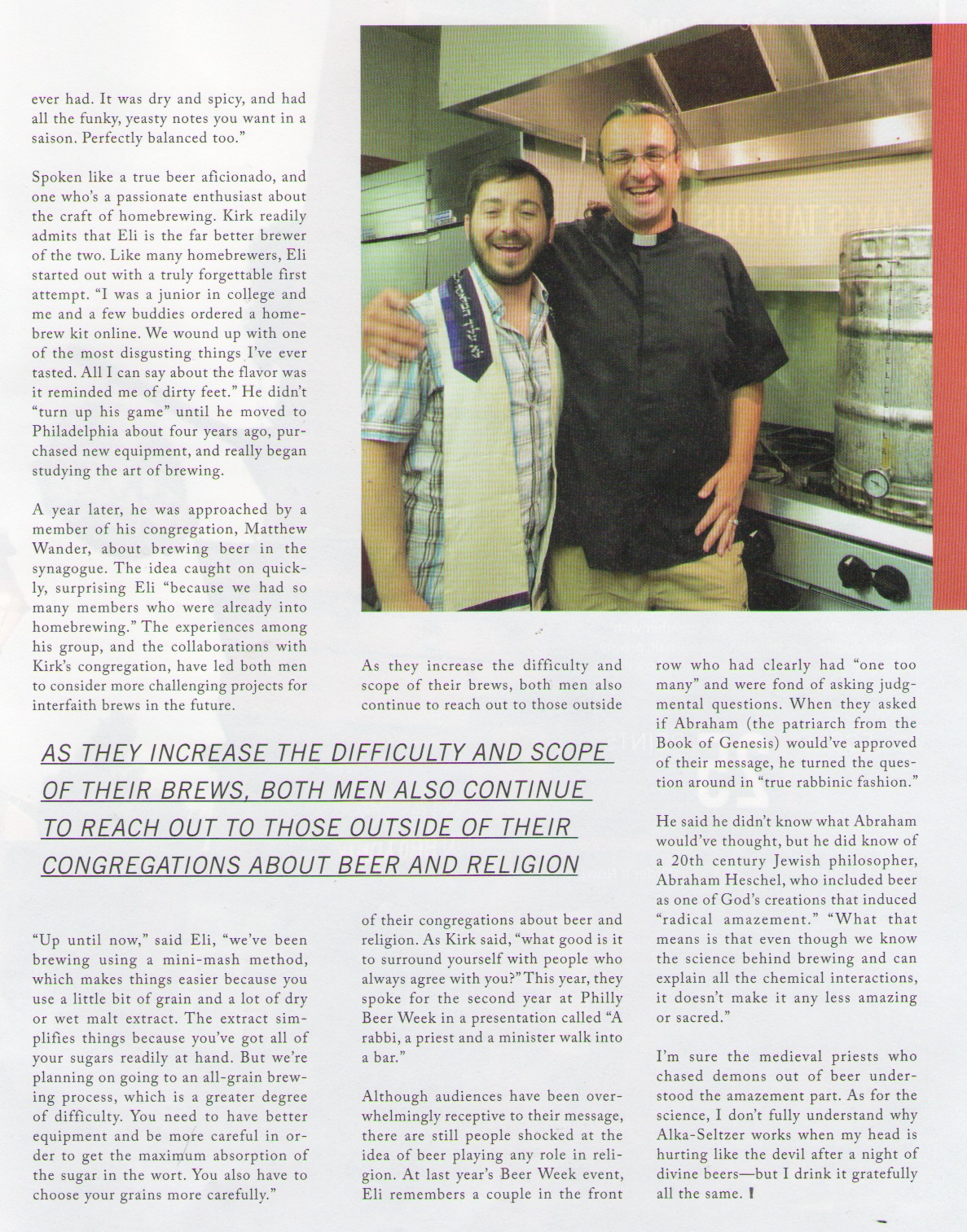
    What works for Reverend Kirk Berlenbach’s homebrew group is love of beer. It’s what led him to a homebrewing collaboration between Berlenbach’s St. Timothy’s Episcopal Church and Rabbi Eli Freedman’s Rodeph Shalom Synagogue. “Eli and I agree on many things about homebrewing, but one of the most important is that the beer isn’t a gimmick to increase attendance. We aren’t looking to draw in people using beer as a hook. For us it’s always been about the love of beer and we would do this whether those outside our congregations noticed or not. At bottom, it’s about understanding people of other faiths and making the world a better place.”

    One of Kirk’s strides toward that better world is in a community garden on the grounds of his church. The garden provides parishioners with plots for vegetables and herbs. In true homebrewer fashion, Kirk’s own small sliver of ground features cascade and centennial hops.

    So how did a reverend get involved with hops and homebrewing? It was a “goofy idea” that started with a beer appreciation club. He invited Lew Bryson to the first event “about 6 or 7 years ago,” just to find out about the styles and history of beer. “We’d also have reps and brewers from various breweries come in for tastings. We dedicated those tastings to various styles or countries or seasonal beers. Before long, we thought, why don’t we try brewing our own? That’s what led us to team up with Eli’s congregation.”

    The reverend and the rabbi met about three years ago. And it wasn’t divine intervention (at least on the face of it) that brought them together, but Home Sweet Homebrew at 20th and Sansom Street. Owners George Hummel and Nancy Rigberg told Eli about a priest who was homebrewing with his congregation.

    They introduced the two and “a few hours and beers later” Kirk and Eli had begun planning their first interfaith brew. With George providing technical advice, the two congregations collaborated on a whole-grain American tripel. “We made ten gallons and split it between us,” said Eli. “Those first encounters were very polite, as you’d expect. We talked a lot about topics we agreed on. But after a few brewing collaborations, I noticed that our discussions moved past politeness to bigger and deeper topics. There was an understanding that allowed us to talk about all sorts of things, even those over which we differed. That’s when I knew our relationship had progressed to another level.”

    Soon, the two groups began participating in each other’s Sabbath services and religious traditions, with beer as an integral component. Last year they collaborated on a saison that was served at Rodeph Shalom’s Sukkot celebration, a fall festival which is traditionally held outdoors. They named their beer “To Everything There’s a Saison” (after the Ecclesiastes verse 3:1).

    The sharing between the congregations has “been so important,” said Kirk. “It’s broadened my understanding of what faith means.” It’s also produced a wide range of beers, including saisons, Belgians, stouts, and porters. The relationship has grown to the point that the two congregations have begun engaging in friendly competitions, such as the “Biblical Brewoff” held a few weeks ago.

    Each group produced three beers for the challenge and presented them to a panel of four judges, which included Danya Henninger, a beer writer, and Carolyn Smagalski, a veteran judge of many homebrew events. The result? St. Tim’s won the overall award, prompting Eli to joke “I guess this means that Judaism isn’t the one true faith.”

    The competition wasn’t without bright spots for Rodeph Shalom, however. One of the congregation’s female brewers Karenanne Jureki produced a hefeweizen that won the “People’s Choice” award. “What was interesting,” said Eli, “was that she used cardamom rather than the traditional orange peel and coriander, which really gave the beer a rich spiciness.” He was also consoled in defeat by one of St. Timothy’s beers, a saison that was “one of the best I’ve ever had. It was dry and spicy, and had all the funky, yeasty notes you want in a saison. Perfectly balanced too.”

    Spoken like a true beer aficionado, and one who’s a passionate enthusiast about the craft of homebrewing. Kirk readily admits that Eli is the far better brewer of the two. Like many homebrewers, Eli started out with a truly forgettable first attempt. “I was a junior in college and me and a few buddies ordered a homebrew kit online. We wound up with one of the most disgusting things I’ve ever tasted. All I can say about the flavor was it reminded me of dirty feet.” He didn’t “turn up his game” until he moved to Philadelphia about four years ago, purchased new equipment, and really began studying the art of brewing.

    A year later, he was approached by a member of his congregation, Matthew Wander about brewing beer in the synagogue. The idea caught on quickly, surprising Eli “because we had so many members who were already into homebrewing.” The experiences among his group, and the collaborations with Kirk’s congregation, have led both men to consider more challenging projects for interfaith brews in the future.

    “Up until now,” said Eli, “we’ve been brewing using a mini-mash method, which makes things easier because you use a little bit of grain and a lot of dry or wet malt extract. The extract simplifies things because you’ve got all of your sugars readily at hand. But we’re planning on going to an all-grain brewing process, which is a greater degree of difficulty. You need to have better equipment and be more careful in order to get the maximum absorption of the sugar in the wort. You also have to choose your grains more carefully.”

    As they increase the difficulty and scope of their brews, both men also continue to reach out to those outside of their congregations about beer and religion. As Kirk said, “what good is it to surround yourself with people who always agree with you?” This year, they spoke for the second year at Philly Beer Week in a presentation called “A rabbi, a priest and a minister walk into a bar.”

    Although audiences have been overwhelmingly receptive to their message, there are still people shocked at the idea of beer playing any role in religion. At last year’s Beer Week event, Eli remembers a couple in the front row who had clearly had “one too many” and were fond of asking judgmental questions. When they asked if Abraham (the patriarch from the Book of Genesis) would’ve approved of their message, he turned the question around in “true rabbinic fashion.”

    He said he didn’t know what Abraham would’ve thought, but he did know of a 20th century Jewish philosopher, Abraham Heschel, who included beer as one of God’s creations that induced “radical amazement.” “What that means is that even though we know the science behind brewing and can explain all the chemical interactions, it doesn’t make it any less amazing or sacred.”

    I’m sure the medieval priests who chased demons out of beer understood the amazement part. As for the science, I don’t fully understand why alka-seltzer works when my head is hurting like the devil after a night of divine beers — but I drink it gratefully all the same.


  • Lager? I Barely Know Her…

    Lager? I Barely Know Her…

    Q: How do you turn German beer into American beer?
    A: Drink it.

    Poor American lager. A whole generation of craft beer lovers grew up associating this once-noble Old World recipe with the thin, low-alcohol stuff favored by rednecks and underage drinkers. (more…)

  • Party Like It’s 1899

    Party Like It’s 1899

    Hohenadel House is Ready to Swing:
    SATURDAY OCTOBER 18th  …  6 pm – 10 pm

    A century ago, when friends called on John Hohenadel at his grand mansion on Indian Queen Lane, they likely joined the old brewmaster in his basement parlor — his “ratzkeller“– for some of his Falls Brewery beer. His plant a few blocks up on Conrad Street produced more than 30,000 barrels a year, the last and most successful enterprise of the family’s 83+ years in East Falls, brewing beer & running saloons, hotels & dancehalls. (more…)